Insider's Guide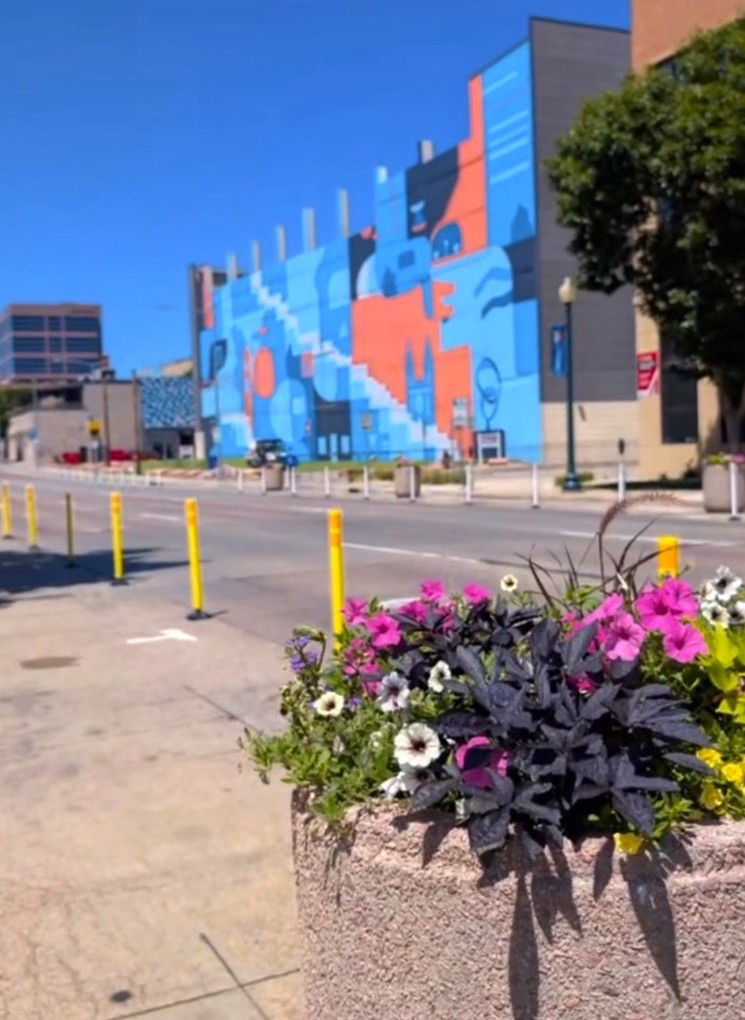
“Traffic calming” is an odd phrase. It sounds technical, maybe even a little dull. But at its core, it asks a very human question: what should our streets feel like for the people using them?
I think about this most as a parent. A crosswalk can look simple on a map, but it feels different when you are standing at the curb with your child’s hand in yours, wondering whether the next driver will slow down.
In those moments, infrastructure is not abstract. It is personal. It either tells you that you belong there, or it makes you feel like you are in the way.
For the month of July, Downtown Sioux Falls tested that question on one of our main corridors into downtown. We added planters, invited food trucks, and commissioned artists to create chalk murals. The goal was not to make driving impossible or to suggest cars do not matter. Cars are part of downtown, and they always will be.
But they are not the only part.
Downtown Sioux Falls has more people, cars, workers, residents, visitors, bikes, deliveries, strollers, wheelchairs, and scooters interacting in close proximity than anywhere else in South Dakota.
That means the number of potential conflict points is high. Downtown districts are complex, and our streets need to reflect that complexity.
Somewhere along the way, many of us got used to thinking of walking as unusual and driving as the default. But legs, bikes, wheels, transit and cars are all ways people move through a city.
Walkability is not anti-car. In fact, a walkable downtown is a place where everyone wins. Cars still get access. Pedestrians can safely move from shop to shop.
Visitors stay longer. Spending goes up. Local businesses benefit. Our community is strengthened by people choosing to spend their time and money here.
Which brings us back to the 10th Street traffic calming pilot. What we have already learned from this temporary project is encouraging – traffic volume did not appear to drop off, but vehicle speeds naturally came down.
People still got through the corridor, but the street felt different.
It also affirmed something important: People respond more to physical design than posted speed limits. A sign can ask drivers to slow down. A well-designed street proactively helps them do it.
That is the lesson worth carrying forward. If we want downtown to be safe, welcoming, economically strong, and full of life, we must build streets for people first, with cars included, not the other way around.
*This “Viewpoint” article was featured in The Dakota Scout and written by DTSF, Inc. CEO, Brandon Hanson